“@acgrayling: Andrew Copson & AC Grayling (eds) ‘Handbook of Humanism’ out soon” <see http://t.co/3tZZyivM0n and request it at your library!
— Andrew Copson (@andrewcopson) March 31, 2015
Latest news and issues
“@acgrayling: Andrew Copson & AC Grayling (eds) ‘Handbook of Humanism’ out soon” <see http://t.co/3tZZyivM0n and request it at your library!
— Andrew Copson (@andrewcopson) March 31, 2015
Religious figures have the least influence on the lives of young Britons – and more say religion is a force for evil than a force for good.
See the full YouGov poll here >>
“Academics, teachers, and parents have today condemned the exclusion of study of the non-religious worldview of humanism from new English GCSE and AS and A level criteria published today by the Government. Together with the British Humanist Association (BHA) and the Religious Education Council of England and Wales (REC), they have urged the Government to think again.
“The draft subject criteria for Religious Studies published for consultation by the Department for Education (DfE) were widely expected to include an optional annex on humanism alongside optional annexes on the six principal religions. This followed the publication of a new curriculum framework for RE last year, endorsed by the Secretary of State for Education, which included non-religious worldviews on an equal footing to each of the principal religions, as well as the issuing of Departmental advice recommending that schools meet the new requirement to promote British values by teaching about ‘beliefs such as… humanism’ as well as religions”.
(BHA report 7th November 2014)
The Department for Education (DfE) have approved the applications from three Harrow bidders: Pinner High School, Harrow View Primary School and Harrow Bilingual Primary School. All three are now aiming to open in September 2016. Pinner High will take up the Heathfield site, Beaulieu Drive, Pinner, whilst Harrow View Primary will be located within the new Kodak development on Harrow View. A location for Harrow Bilingual Primary is yet to be decided by the Education Funding Agency (a department of the DfE).
secondary school (ages 11 to 18), 900 mainstream places, 240 post-16 places, 12 special educational needs places
8 successful Harrow schools:
Bentley Wood High School
Canons High School
Harrow High School
Hatch End High School
Nower Hill High School
Park High School
Whitmore School
Rooks Heath College
are collaborating to extend their high standards by setting up a brand new community secondary school. The new school will build on the high academic standards achieved at these popular schools and create 1,152 places. The proposed school will also offer specialist provision for twelve pupils with autistic spectrum disorders, sustaining their education in a mainstream setting with specialised support and facilities.
primary (ages 3 to 11), 630 places (plus 26 nursery places), 12 special educational needs places
7 successful Harrow academies:
Bentley Wood High School
Canons High School
Harrow High School
Hatch End High School
Nower Hill High School
Park High School
Rooks Heath College
are collaborating to extend their high standards by setting up a brand new primary school. Harrow View Primary School will serve a new community in the Harrow View area which is being constructed on the old Kodak site. The proposed school will also include a 26 place nursery and specialist provision to support 12 pupils with autistic spectrum disorders in a mainstream setting.
primary (ages 4 to 11), 420 primary places
Harrow Bilingual Primary School will open in September 2016 with 60 pupils and grow to full capacity of 420 in 2022. The school will use the freedoms offered to free schools to offer a bilingual curriculum. The school recognises the positive role a bilingual curriculum can play in the cultural development of children, with lessons being taught in both English and French.
A group of passionate local parents are behind the school, led by Ian Fernandes. The school will be partnered and supported by Holy Trinity Primary School, rated ‘good’ by Ofsted. The team includes Penny Roberts, chair of governors for St Luke’s School, and Christian Penhale and Alistair Land of Harrow School.
The ‘Teach Evolution, Not Creationism’ campaign. An alliance of the BHA and 43 scientists and philosophers. The campaign began in 2002. In 2014 this is their statement of success:
“We’re very pleased to announce that as of 2014, the aims of this campaign have largely been met.
“In June 2014, the Government updated its Free Schools and Academies funding agreements to require all such schools to teach evolution, and to preclude the teaching of creationism as science. It also clarified that the same requirements were implicit for all English state schools through the requirement that they teach a ‘broad and balanced’ curriculum.
“In August 2014, the Government announced it would close the loophole which allowed creationist private schools to receive state funds through a nurseries scheme.
“And finally in September 2014, a module on evolution was added to the national curriculum in primary schools, meaning that all English state-funded schools from primary level onwards must teach evolution, and not creationism.
“We’re absolutely delighted that this campaign has been a success and would like to thank all our supporters for making this happen.”
EvoltionNotCreationism Campaign
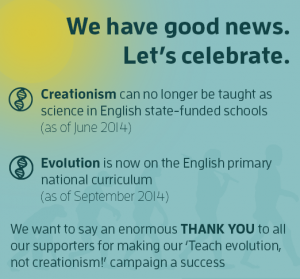
We’re hugely thankful to our supporters for our ‘Teach evolution, not creationism!’ success https://t.co/TLVRx01TYn pic.twitter.com/2FM82l9TBi
— British Humanists (@BHAhumanists) September 2, 2014
The Oxford Declaration on Freedom of Thought and Expression
The 2014 World Humanist Congress, gathered in Oxford, UK, on 8-10 August 2014, adopted the following declaration on freedom of thought and expression:
All around the world and at all times, it is freedom of thought and freedom of expression that have proved the most essential conditions for human flourishing, but every generation must face new threats to these fundamental freedoms. Knowing this, we maintain:
The right to freedom of thought and belief is one and the same right for all. The human right articulated in Article 18 of the Universal Declaration of Human Rights and elaborated elsewhere is and should be a single right, indivisible, protecting the dignity and freedom of all people by protecting their right to their personal beliefs, whatever those beliefs, religious or non-religious. As Article 7 of the Declaration says, ‘All are equal before the law and are entitled without any discrimination to equal protection of the law.’
No one anywhere should ever be forced into or out of a belief. Freedom of thought implies the right to develop, hold, examine and manifest our beliefs without coercion, and to express opinions and a worldview whether religious or non-religious, without fear of coercion. It includes the right to change our views or to reject beliefs previously held, or previously ascribed. Pressure to conform to ideologies of the state or to doctrines of religion is a tyranny. Laws that prescribe or criminalise beliefs contravene human dignity and must be abolished. Every citizen of every state has the right to demand the repeal of such laws, and all states should support those, wherever they are, who demand that their social freedoms and personal liberty be upheld.
The right to freedom of expression is global in its scope. The human right articulated in Article 19 of the Universal Declaration of Human Rights includes the right to ‘seek, receive and impart information and ideas through any media and regardless of frontiers’. No parochial nationalism or state insecurity should prevent the global human community from fulfilling the promise of our new technologies, our mass media, our social media, and our personal access to transnational networks. States should invest adequate resources to allow their citizens’ participation in this global conversation.
There is no right not to be offended, or not to hear contrary opinions. Respect for people’s freedom of belief does not imply any duty or requirement to respect those beliefs. The expression of opposition to any beliefs, including in the form of satire, ridicule or condemnation in all media and forms is vital to critical discourse and any restraint that is exercised in this expression must be in accordance of article 29 of the Universal Declaration of Human Rights, namely to protect the rights and freedoms of others. The best response to the expression of a view we disagree with is to reply to it.Violence and censorship are never legitimate responses. All laws that criminalise language on grounds of ‘blasphemy’ or of offence to beliefs and values impede human freedom and should be abolished.
States must not restrict thought and expression merely to protect the government from criticism. States that criminalise criticism of government policies or officials as treasonous or seditious, or as threats to security, are not “strong governments” championing the best interests of the public, but censorious bullies exercising tyranny in their own interests. States should ensure in the law of the land, in their education systems, and in the conduct of their national life generally, that freedom of thought and expression are actively promoted and pursued to the real benefit of every member of society.
Freedom of belief is absolute but the freedom to act on a belief is not. As responsible members of a community we accept that our freedom to act must sometimes be restricted, if and only if our actions would undermine the rights and freedoms of others. Freedom of belief cannot legitimise overriding the principles of non-discrimination and equality before the law. These balances can be hard to strike but with a focus on freedom and human dignity, we believe legislators and judiciaries can strike them in a progressive manner.
We assert the principles of democracy, human rights, the rule of law, and secularism as providing the firmest foundation for the development of open societies where freedom of thought and expression will be protected and promoted.
We commit ourselves in all our work to uphold and promote existing rights to freedom of thought and expression within the international human rights framework and to resist national and international restrictions on the right of individuals to think for themselves freely and to openly express their views without fear.
We urge each of our member organizations and humanists worldwide to uphold these values in their own lives; to promote in their communities greater public understanding of the rights to freedom of thought and freedom of expression for all; to urge their governments to promote these values; and to join with humanists and others globally in defending and advancing them to the benefit of all humanity.
The Oxford Declaration on Freedom of Thought and Expression
Here is a link to the BHA’s full response on the ‘Trojan Horse’ conspiracy and the recently published DfE commissioned enquiry.
BHA responds to publication of Government report into Birmingham schools
Here is an article from The Huffington Post (3rd June 2014) on a report by the Church of England on chaplaincy in UK church schools. It points to the Church’s open aim of using school chaplains to replenish the declining Anglican community. ‘Get them young and use public funds to do it.’
Here is the link: http://www.huffingtonpost.co.uk/stephen-evans/school-chaplains-the-chur_b_5416125.html